
Trapped crossover
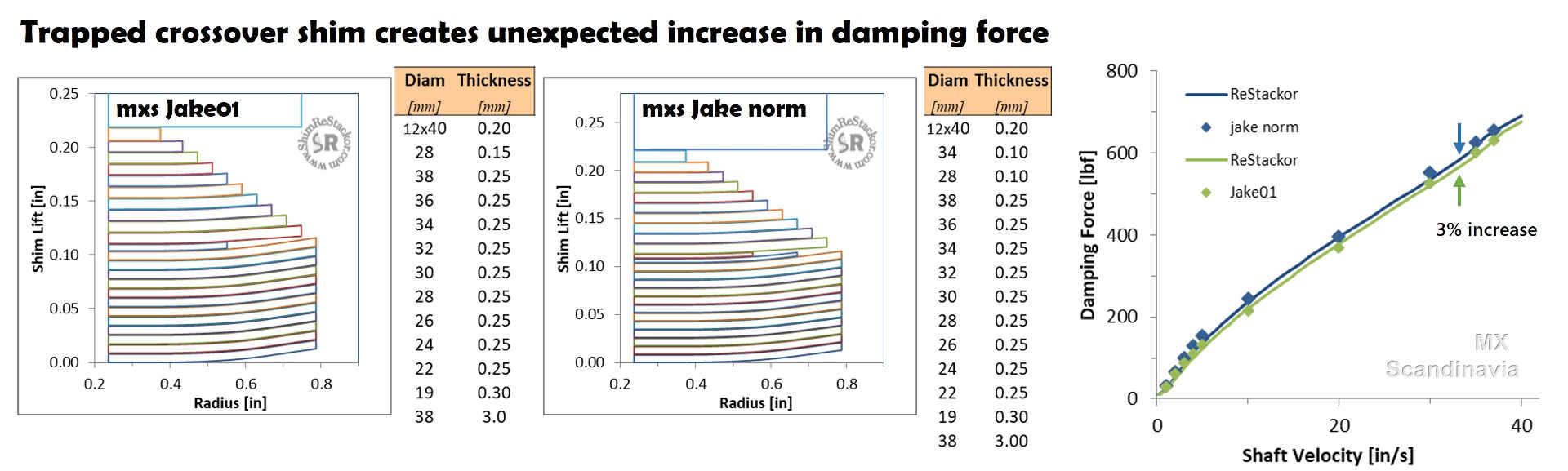
MXScandinavia on Thumper Talk demonstrated operation of a trapped crossover (linky sample apps) and compared performance to a simple single shim crossover. The two shim stacks are identical with the single difference of replacing the crossover with a 34.1/28.1 split shim pair.
By the thickness cubed rule (shim fac), the replacement shim pair should be 40% softer than the single 28.15 crossover shim. In addition, the split shim pair forms a 0.2 mm crossover gap making the shim stack softer than the single shim 0.15 mm crossover gap.
However, dyno testing shows the opposite effect with the split shim pair producing 3% more damping force. The reason for the difference is the larger 34.1 crossover shim becomes trapped in the closing crossover gap reducing the “effective” crossover gap to 0.1 mm instead of the expected 0.2 mm crossover gap.
Shim ReStackor closely follows the dyno test data and confirms the occurrence of the trapped crossover shim increasing the damping force of the theoretically softer stack.
High speed stack (jake norm)
A general misconception in shim stack tuning is the high speed stack controls high speed damping. That creates the perception removing shims from the high speed stack “loosens-up” high speed damping.
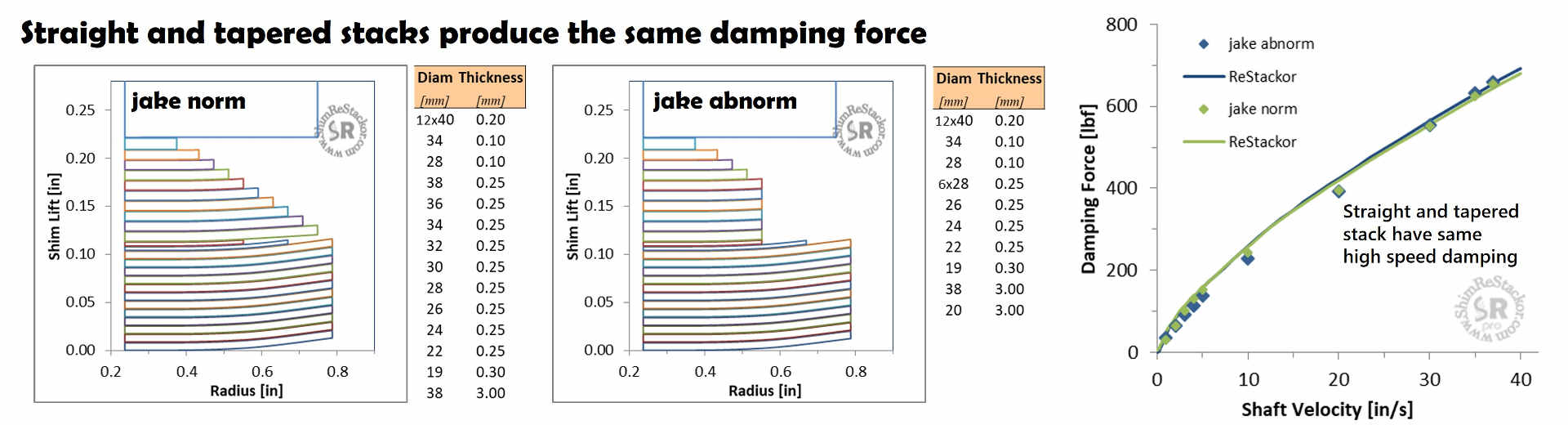
Ride tests of the “jake norm” stack determined the setup needed softer high speed damping to get better ground compliance. Jake wanted to replace the stack taper with a straight stack of six shims with the thinking the softer high speed stack would “loosen-up” high speed damping.
MXScandinavia ran the dyno test and the two configurations (data points) show no difference in damping. Shim ReStackor calculations (shown by the lines) show the same thing.
To get softer high speed damping while keeping low speed the same requires using a ring-shim to preload the stack (linky, fundamentals).
rmz250 split shim crossover
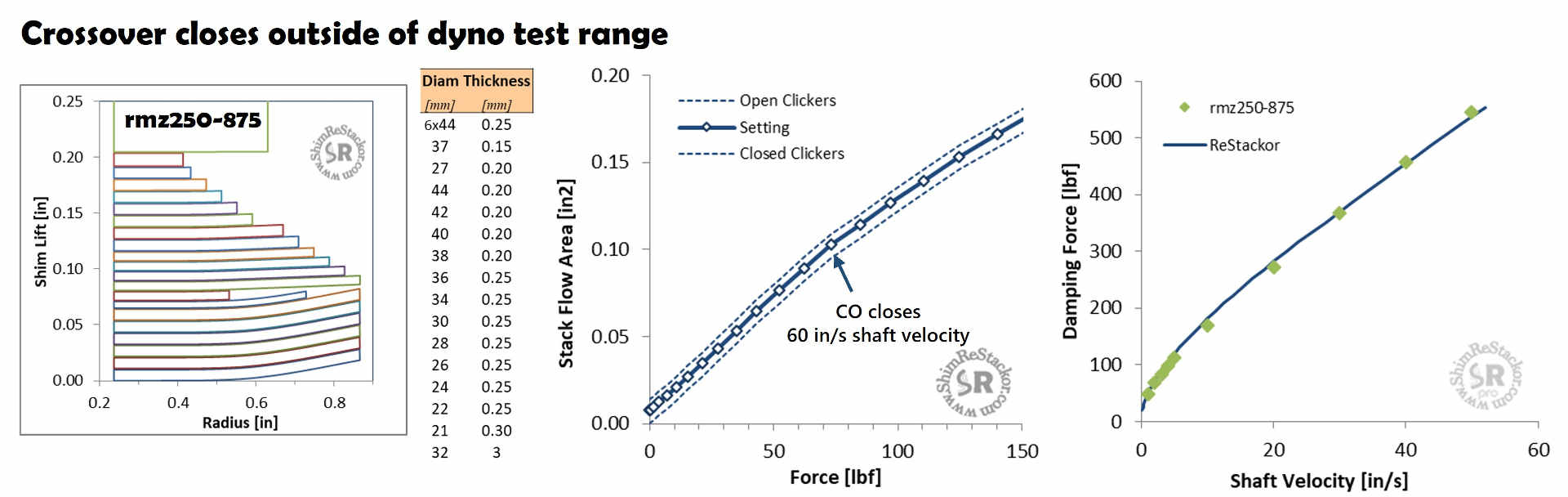
Split crossovers (linky sample apps) use two shims to form the crossover gap. Split shims smooth the bend radius at the crossover shoulder to prevent kinking of the face shims on the sharp shoulder of a single crossover shim.
Valving Logic dyno testing of an rmz250 used a split shim crossover. Deflection of the high speed stack by the interactive crossover delayed closure of the crossover to 64 in/sec. However, the dyno was not capable of testing beyond 50 in/sec. The data provides no information on the expected damping force increase after the crossover gap closes.
High speed closure of crossover gaps and valve port flow restrictions can significantly increase high speed damping making extrapolation of dyno data beyond the test range risky.
Trapped dirt
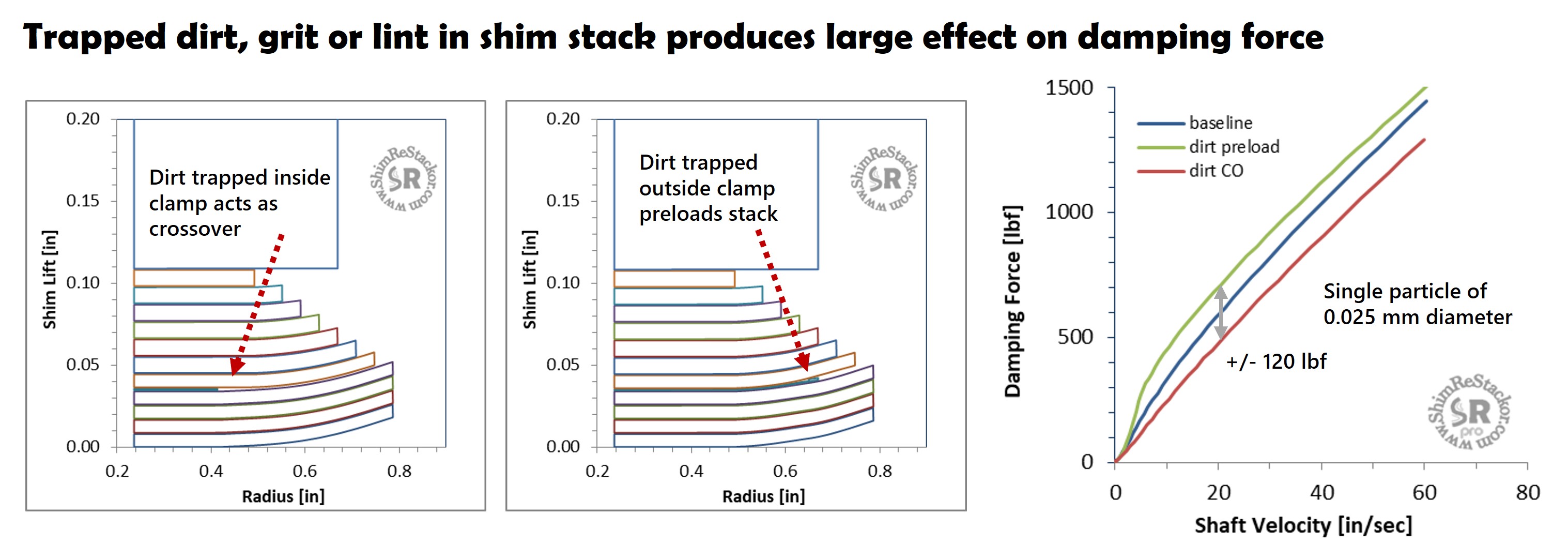
Shim stacks are extremely sensitive to trace contaminants. A single particle from 800 grit sandpaper (0.025 mm diameter) trapped in the shim stack changes the damping force by 120 lbf.
Particles trapped inside of the shim stack clamp produce a crossover gap and reduce the damping force. Particles trapped outside of the clamp preload the shim stack driving the damping force up. A single flex from 800 grit sandpaper creates a +/- 20% damping force uncertainty depending on location of the particle inside or outside the stack clamp diameter.
For fielded shocks, any dirt, grit or lint trapped in the shim stack is ground up and spit out after a couple of hours of operation. Free of debris the shock returns to the nominal “clean stack” damping force.
Dyno tests, on the other hand, are only run for a couple of minutes. Trace contaminates, in the range of 800 grit sand paper, significantly alter the damping force measured. That creates problems comparing back-to-back tests with subtle differences in shim stack tuning and +/- 20% damping force noise.
Test-to-test repeatability shows up in dyno tests series fine tuning compression damping where several back-to-back tests are run. Through that test series the rebound shim stack is left untouched, however it is not uncommon to see test-to-test drifts in rebound with an occasional rouge test drifting off target by 10% or more.
Failure to repeat rebound raises questions on the fidelity of the compression measurement, which was the goal of the test series.