
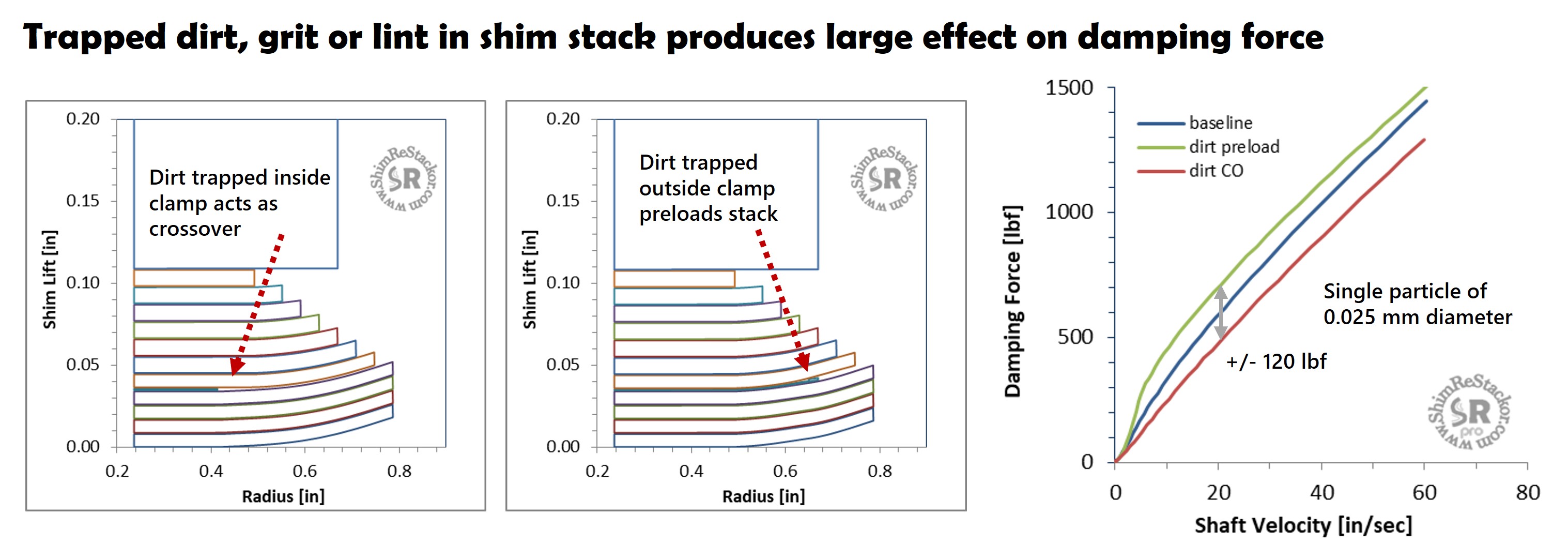
Shim stacks are extremely sensitive to trace contaminants. A single particle from 800 grit sandpaper (0.025 mm diameter) trapped in the shim stack changes the damping force by 120 lbf.
Particles trapped inside of the shim stack clamp produce a crossover gap and reduce the damping force. Particles trapped outside of the clamp preload the shim stack driving the damping force up. A single flex from 800 grit sandpaper creates a +/- 20% damping force uncertainty depending on location of the particle inside or outside the stack clamp diameter.
For fielded shocks, any dirt, grit or lint trapped in the shim stack is ground up and spit out after a couple of hours of operation. Free of debris the shock returns to the nominal “clean stack” damping force.
Dyno tests, on the other hand, are only run for a couple of minutes. Trace contaminates, in the range of 800 grit sand paper, significantly alter the damping force measured. That creates problems comparing back-to-back tests with subtle differences in shim stack tuning and +/- 20% damping force noise.
Test-to-test repeatability shows up in dyno tests series fine tuning compression damping where several back-to-back tests are run. Through that test series the rebound shim stack is left untouched, however it is not uncommon to see test-to-test drifts in rebound with an occasional rouge test drifting off target by 10% or more.
Failure to repeat rebound raises questions on the fidelity of the compression measurement, which was the goal of the test series.