MXScandinavia interactive crossover
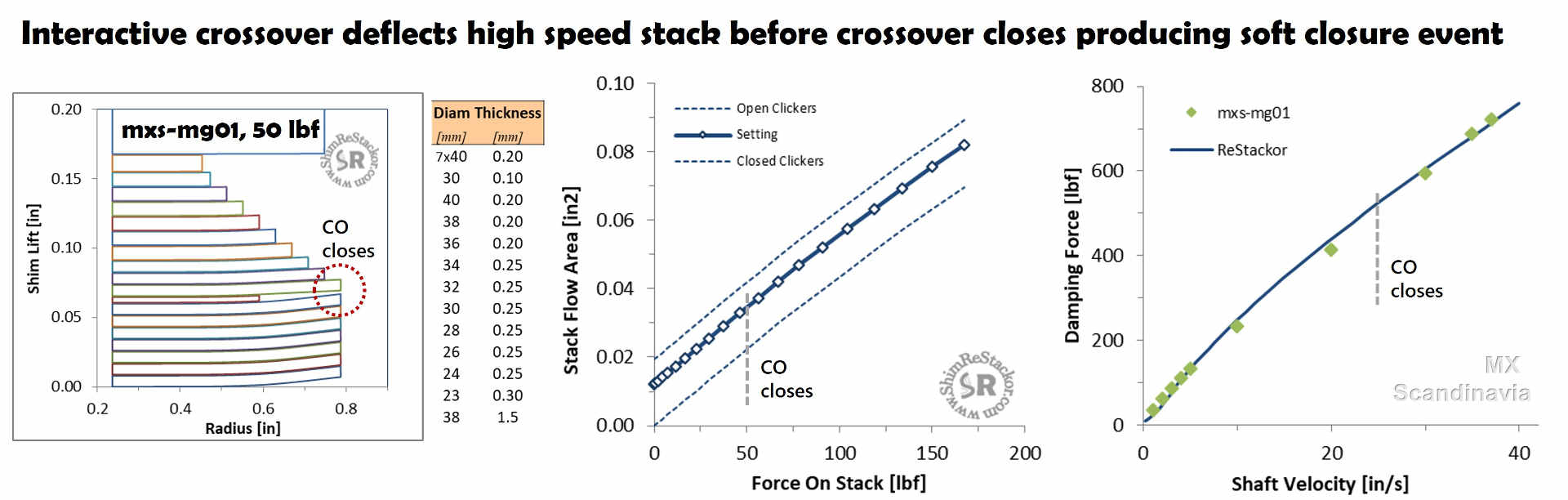
Interactive crossovers (linky sample apps) use a shim diameter that is larger than the shim stack clamp. The larger crossover diameter transfers force from the face shims directly into the high speed stack forcing the high speed stack to deflect before the crossover closes. Interaction with the high speed stack softens the crossover closure event.
MXScandinavia dyno tests on Thumper Talk evaluated the performance of an interactive crossover configuration.
Shim ReStackor analysis of the configuration shows the crossover closes at a shaft velocity of 26 in/sec. Due to the shim stack configuration there is virtually no change in stack stiffness or damping force at the crossover closure confirming the dyno test results.
High speed stack (mx3)
A common misconception in shim stack tuning is the face shims control low speed damping and the stack taper controls high speed. Dyno tests and Shim ReStackor show shim stacks do not work that way.
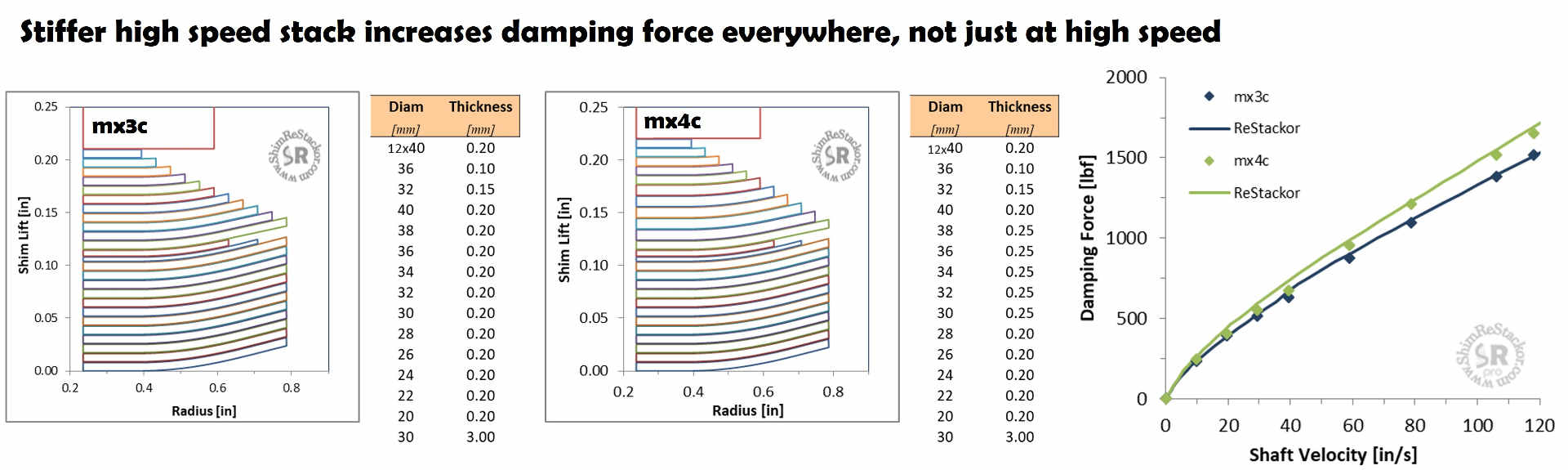
The dyno example below from the MXScandinavia thread on Thumper Talk replaces the 0.2 mm shims in the stack taper section with stiffer 0.25 mm thick shims.
The dyno test results show the shim stack is stiffer everywhere across the speed range, not just at high speed. Shim ReStackor calculations (lines) show the same thing.
High speed damping can be stiffened by tuning the crossover or softened using a preloading ring-shim (linky, fundamentals).
rmz450 faux crossover
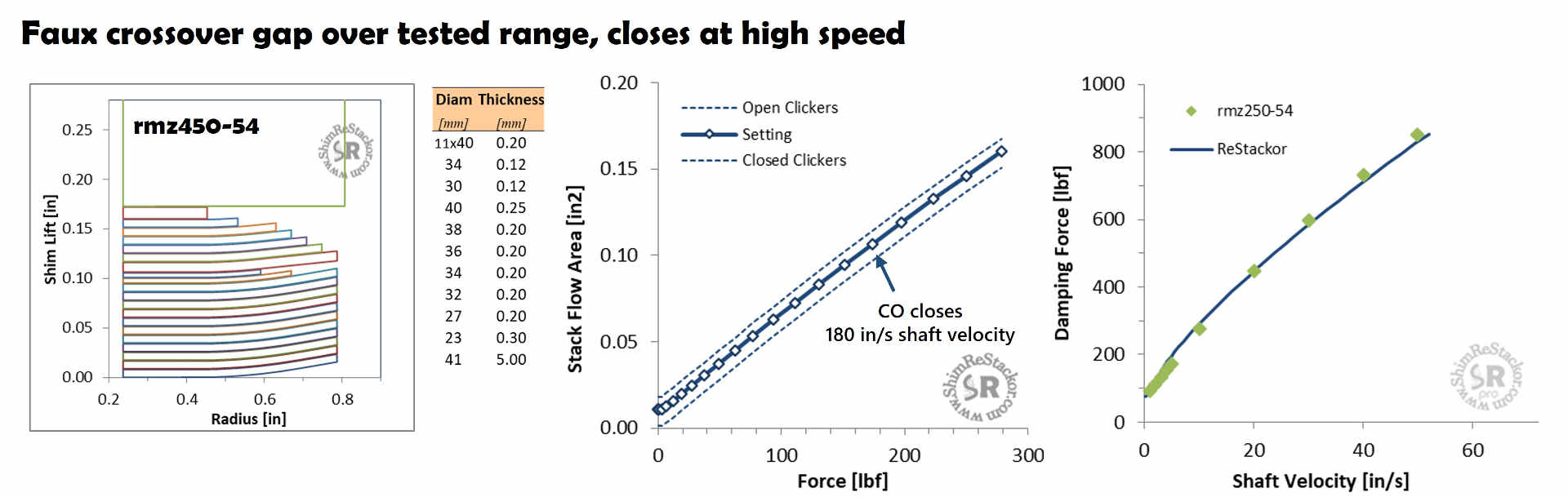
A faux crossover gap never closes. Faux gaps are created by large crossover shim diameters, stiff low speed stacks or soft high speed stacks that do not produce enough force to close the crossover gap.
Valving Logic dyno tests of an rmz450 shock on Thumper Talk demonstrate the operation of a faux crossover.
Shim ReStackor analysis of the configuration shows the crossover gap eventually closes at a shaft velocity of 180 in/sec. However, the soft high speed stack used in the configuration produces virtually no change in damping force at the crossover closure. In that sense, the configuration demonstrates “faux” over the range tested.
rmz450 trapped crossover
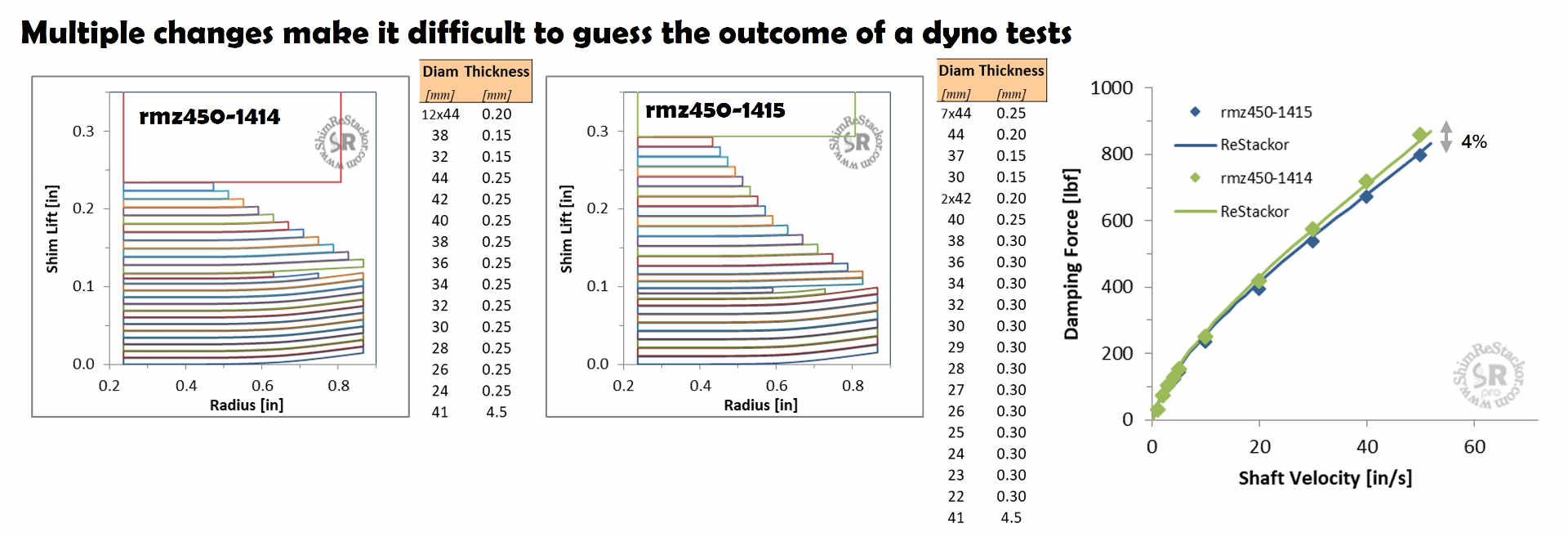
Valving Logic on Thumper Talk tested trapped crossover shim stack configurations. Differences in the number of face shims, crossover configuration and high speed stack stiffness makes it difficult to guess the expected damping force differences between the two shim stack configurations.
Computing the damping force of complex shim stack configurations with multiple differences in the crossover configuration, high speed stack and clamp is the central purpose of Shim ReStackor. The computed results (lines) closely follow the dyno test data (symbols).